Why now
For most of the last decade, European solar developers had room to be approximately right. Margins were wide enough that a design which captured most of a project's value was fine. The gap between "good enough" and "best" was lost upside — real, but survivable.
That cushion is gone.
The pressure showed up first in high-penetration markets like Denmark, where heavy wind and tight interconnection pushed spot prices negative for more hours each year. It has now arrived, hard, in Germany — record negative-price hours, falling wholesale prices, and grid and curtailment rules shifting mid-development. The post-subsidy, spot-revenue model that underwrote projects in 2020–2022 no longer clears the same debt.
When margins compress toward zero, the cost of a suboptimal design changes category. It's no longer forgone upside. It can be the difference between a project that services its debt and one that doesn't. In that environment, "how many designs did you actually test before you committed?" stops being an academic question.
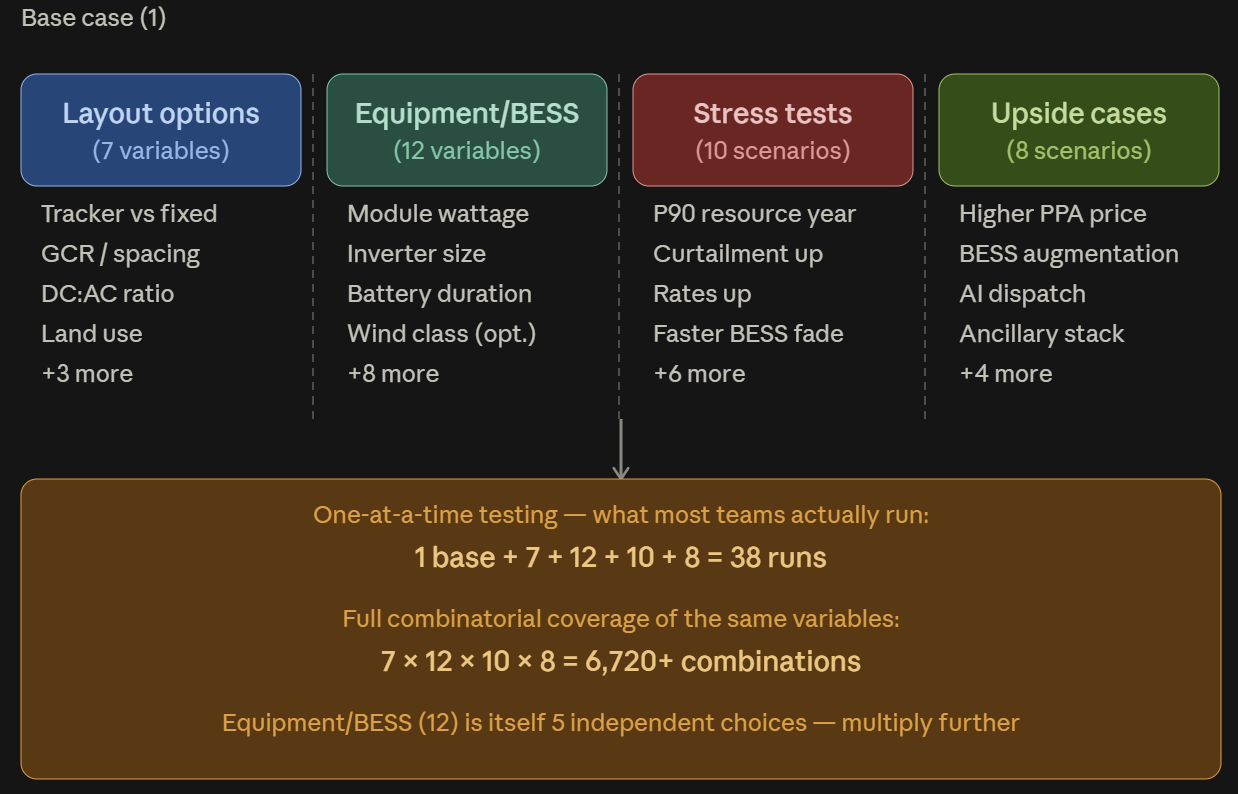
For most teams, the honest answer is: not many. Not because they don't want to — because of what testing one design actually costs today.
What one answer costs today
Ask a development team to evaluate a solar-plus-storage project, and here's roughly what happens before anyone sees a number.
Layout gets drafted by hand. Someone lists the input variations worth checking — tilt, ground-coverage ratio, battery duration. Then the scripts start: one for capacity, a third-party API for yield, and — because storage forces it — a dispatch simulation, since a battery's value depends on when it cycles against a price signal, not just how big it is.
Results get extracted. A handful of scenarios get filtered down to "the ones worth looking at." An 8760 profile gets exported and handed to finance, where it enters a separate model for revenue, financing, and tax. Then procurement changes a number — an equipment price, a grid-connection cost — and the whole chain runs again, by hand, from the top.